
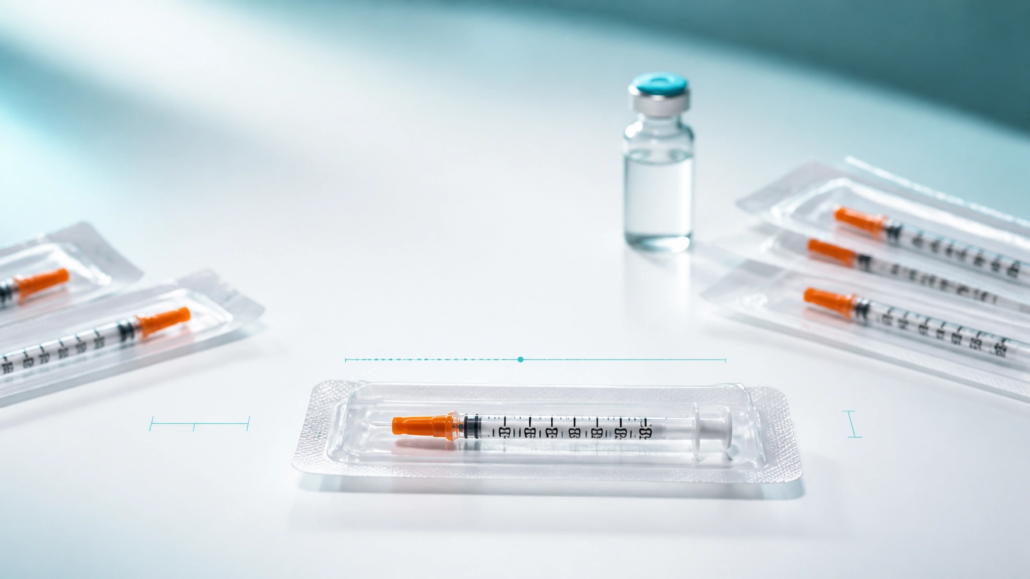
How to Choose the Right Insulin Syringe (Gauge, Length & Capacity, Compared)
Choosing among insulin syringes requires more than selecting the lowest available price. Capacity, gauge, needle length, unit markings, packaging, and disposal requirements all influence whether a syringe is appropriate for your prescribed insulin regimen.
At Budget Medical Supply, we understand that individuals, caregivers, and healthcare professionals require dependable diabetic supplies with clear specifications and reliable fulfillment. This guide explains the primary factors to evaluate before purchasing insulin syringes. It is educational in nature and does not replace the instructions of your prescriber, pharmacist, or diabetes educator.
1. Confirm the Insulin Concentration Before Purchasing
1.1 Match the syringe to the insulin
The information in this article primarily applies to U-100 insulin, which contains 100 units per milliliter. A U-100 vial should be used with a syringe calibrated for U-100 insulin.
Using an incorrect concentration or syringe calibration can create a serious dosing error. The American Diabetes Association explains the importance of matching insulin concentration and syringe type.
Before ordering, verify:
- The insulin concentration, such as U-100.
- The prescribed dose in units.
- Whether your regimen uses a vial and syringe rather than an insulin pen.
- The required unit increments, particularly if you use half-unit doses.
If your insulin or dosing instructions have changed, confirm your syringe selection with your healthcare provider before placing an order.
2. Compare Insulin Syringe Capacity: 0.3 mL, 0.5 mL, and 1.0 mL
Capacity refers to the maximum amount of liquid the barrel can hold. For U-100 insulin, the common conversions are:
- 0.3 mL = up to 30 units
- 0.5 mL = up to 50 units
- 1.0 mL = up to 100 units
As a general purchasing principle, select the smallest syringe that comfortably accommodates your largest prescribed dose. A smaller barrel can make the markings easier to see and may support more precise measurement for lower doses.

2.1 Capacity comparison
| Syringe capacity | Maximum U-100 dose | Common reason to choose it | Primary consideration |
|---|---|---|---|
| 0.3 mL | Up to 30 units | Lower doses or doses requiring fine measurement | Typically offers excellent visibility for small doses |
| 0.5 mL | Up to 50 units | Moderate doses | Provides a practical balance between capacity and readability |
| 1.0 mL | Up to 100 units | Larger doses | Offers greater capacity, although markings may appear more compressed |
2.2 Practical examples
- A prescribed dose of 18 units may be easier to measure with a 0.3 mL syringe.
- A prescribed dose of 40 units may require a 0.5 mL syringe.
- A prescribed dose of 75 units generally requires a 1.0 mL syringe.
These examples are not dosing recommendations. Your largest prescribed dose, not an estimated average, should guide the capacity selection. If your doses vary significantly, ask your diabetes care team whether one syringe size is appropriate for all injections or whether different sizes are warranted.
3. Understand Gauge: 29G vs. 30G vs. 31G
Gauge describes the thickness of the needle. The numbering system can initially appear counterintuitive:
A higher gauge number indicates a thinner needle.
Therefore:
- 29G is thicker than 30G and 31G.
- 30G is thinner than 29G but thicker than 31G.
- 31G is generally the thinnest of these three options.

3.1 Gauge comparison
-
29G
- Slightly thicker needle construction.
- May provide a firmer feel during handling.
- Can be considered when a particular insulin or regimen requires a thicker needle, subject to clinical guidance.
-
30G
- A widely used middle-ground option.
- Combines a relatively fine needle with practical handling characteristics.
-
31G
- Thinner needle that many users select for comfort.
- May be more delicate and require careful handling.
The American Diabetes Association notes that higher-gauge needles are thinner and may be associated with less discomfort, while lower-gauge needles may allow faster delivery for larger doses. Comfort, insulin viscosity, dose volume, and personal technique should all be considered.
Do not change gauge solely to address injection discomfort without discussing the change with your healthcare professional. A thinner needle is not automatically the correct choice for every person or regimen.
4. Select the Appropriate Needle Length
Insulin is generally delivered into the subcutaneous tissue beneath the skin. Needle length affects injection technique and the possibility of reaching muscle, particularly in lean individuals or at certain injection sites.
4.1 Short needles: approximately 4 mm or 5/16 inch
A 4 mm needle is commonly associated with insulin pen needles, while 5/16 inch equals approximately 8 mm and is a common short insulin syringe length.
Shorter options may:
- Reduce the likelihood of reaching muscle for many adults.
- Support a more comfortable injection experience.
- Be suitable for a wide range of body types when recommended by a clinician.
Because 4 mm and 5/16-inch needles are not the same length, read the product specification carefully. Do not assume that “short” indicates a single standardized measurement.
4.2 Standard length: approximately 1/2 inch
A 1/2-inch needle, approximately 12.7 mm, is a traditional insulin syringe length. Some adults may use this length under the direction of their healthcare provider, particularly when it is already established in their injection routine.
Longer needles may require specific attention to injection angle, skin-fold technique, and injection site.
4.3 Longer length: approximately 5/8 inch
A 5/8-inch needle, approximately 16 mm, is longer than the sizes commonly selected for many modern subcutaneous insulin injections. It should not be chosen merely because it appears to provide greater reach.
Use a longer needle only when the product is specifically appropriate for your prescribed regimen and your healthcare professional has confirmed the length. Needle length should be individualized, especially for children, very lean adults, or people with a history of injecting into muscle.
5. Review Barrel Markings and Unit Precision
5.1 Units are not interchangeable with milliliters
A U-100 syringe is calibrated in insulin units. For U-100 insulin:
- 100 units = 1.0 mL
- 50 units = 0.5 mL
- 30 units = 0.3 mL
Do not use a standard medication syringe marked only in milliliters to measure insulin unless specifically directed by a qualified professional. The calibration may not correspond to your prescribed dose.
5.2 Examine the smallest graduation
Syringes may feature:
- Half-unit markings, useful for certain lower or finely adjusted doses.
- One-unit markings, common for many routine doses.
- Two-unit markings, more frequently found on some 1.0 mL syringes.
When comparing insulin syringes, verify the smallest increment printed on the barrel. If your prescribed dose requires half-unit precision, a syringe with only two-unit increments may not be suitable.
5.3 Read the plunger consistently
When measuring, align the top edge of the plunger gasket closest to the needle with the desired unit marking. Hold the syringe at eye level and use adequate lighting. If the markings are difficult to see, consult your pharmacist or diabetes educator rather than estimating.
6. Store Insulin Syringes and Insulin Correctly
Insulin syringes and insulin have different storage requirements.
6.1 Syringe storage
Keep unused insulin syringes:
- In their original sterile packaging.
- In a clean, dry location.
- Away from excessive heat, moisture, dust, and direct sunlight.
- Out of reach of children and pets.
Do not use a syringe if the package is torn, wet, punctured, or otherwise compromised. Disposable insulin syringes should generally be used once and discarded unless your healthcare provider gives different written instructions.
6.2 Insulin storage
Insulin storage varies by product. Unopened insulin is often refrigerated within the temperature range specified by the manufacturer, while in-use insulin may be stored at room temperature for a limited period. These conditions differ by insulin type and brand.
Always follow the package insert and pharmacist’s instructions. Do not use insulin that has been frozen, exposed to excessive heat, or changed in appearance in a manner inconsistent with the product instructions.
7. Dispose of Used Insulin Syringes Safely
Used insulin syringes are sharps and require responsible handling.
7.1 Immediate disposal
After use:
- Place the entire syringe directly into an appropriate sharps container.
- Do not bend, break, or remove the needle by hand.
- Avoid recapping when you have immediate access to a sharps container.
- Never share a syringe or needle with another person.
The FDA recommends using a puncture-resistant, leak-resistant sharps disposal container. Keep the container upright and inaccessible to children and pets.
7.2 Closing and disposing of the container
Do not overfill a sharps container. Close and seal it when it reaches the marked fill line or approximately three-quarters full. Then follow your local health department, pharmacy, sanitation department, or community program instructions.
Never place loose needles or syringes in household trash, recycling bins, or toilets. Disposal requirements may vary by state or municipality, and unforeseen circumstances may affect available collection programs.

8. Purchasing Insulin Syringes from Budget Medical Supply
Budget Medical Supply has served as a trusted medical-supply partner since 2001. We provide diabetic supplies and daily living products to individuals, caregivers, and healthcare professionals nationwide.
When reviewing our current medical supply selection, compare each insulin syringe listing by:
- U-100 compatibility
- Capacity
- Gauge
- Needle length
- Unit markings
- Quantity and packaging format
- Brand and product specifications
Depending on the product, you may find prepacked or bulk purchasing formats suited to personal use, caregiving responsibilities, or clinical supply management. Availability, packaging, and product specifications may change without notice.
We support practical purchasing flexibility through Klarna and Affirm, subject to applicable approval and payment terms. We also provide expedited fulfillment through USPS and FedEx, although delivery timing may vary because of carrier schedules, weather, holidays, address limitations, or other circumstances beyond our control.
9. Final Selection Checklist
Before purchasing insulin syringes, confirm:
- Your insulin concentration: Is it U-100?
- Your maximum dose: Will the syringe capacity accommodate it?
- Your gauge preference: Is 29G, 30G, or 31G appropriate?
- Your needle length: Has your healthcare professional confirmed the length?
- Your markings: Do the graduations support your prescribed dose?
- Your quantity: Is a prepack or bulk format more practical?
- Your disposal plan: Do you have an appropriate sharps container?
- Your delivery needs: Have you allowed sufficient time for shipping?
We invite you to review Budget Medical Supply’s diabetic-care products and contact our team with questions about product specifications or ordering assistance. You may reach us at 888-827-4472, Monday through Friday from 9:00 a.m. to 5:00 p.m. Eastern Time and Saturday from 10:00 a.m. to 2:00 p.m. Eastern Time.
Select carefully. Verify the specifications. When in doubt, consult your healthcare professional before changing syringe capacity, gauge, or needle length.

