
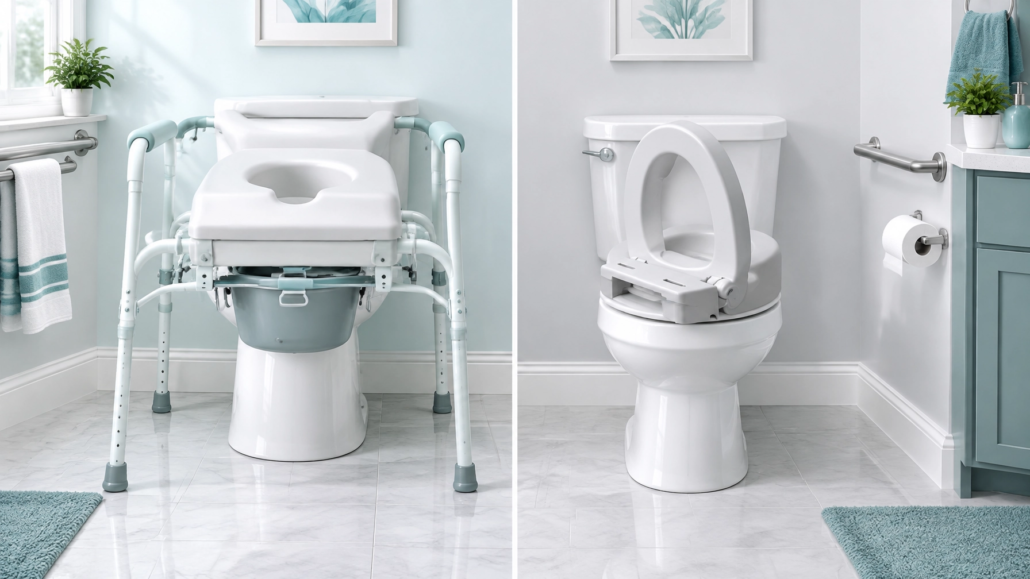
Toilet Lift for Elderly vs. Raised Toilet Seat: Which Is Safer for Your Bathroom?
Selecting the right bathroom equipment is not simply a matter of choosing the most advanced device. The appropriate solution depends on strength, balance, transfer ability, caregiver support, bathroom layout, and budget. A raised toilet seat can make a meaningful difference for an older adult who can still stand independently or with limited assistance. A powered toilet lift, by contrast, is designed to provide mechanical support when standing from the toilet has become significantly more difficult.
In this direct comparison, we examine the toilet lift for elderly users versus a raised toilet seat across the factors that matter most: safety, stability, ease of use, installation, caregiver effort, cost, and user suitability.
Educational disclaimer: This article is provided for general educational purposes only. Budget Medical Supply does not provide medical advice, diagnoses, or individualized treatment recommendations. Consult a qualified healthcare professional, occupational therapist, or physical therapist for guidance specific to your condition or transfer needs.
1. At-a-Glance Comparison
| Consideration | Powered Toilet Lift | Hinged Raised Toilet Seat |
|---|---|---|
| Primary function | Mechanically assists sitting and standing | Increases toilet height |
| Best suited for | Significant weakness, balance limitations, or high caregiver burden | Mild to moderate difficulty bending or rising |
| Transfer assistance | Provides active lifting support | User must still generate most of the force |
| Installation | Usually low-tool, but requires careful fit and clearance checks | Hardware installation using the existing toilet seat and lid |
| Bathroom footprint | Larger frame may require additional clearance | Similar footprint to a standard toilet |
| Caregiver effort | Can substantially reduce hands-on lifting | Reduces effort but may not eliminate physical assistance |
| Upfront cost | Generally higher | Generally lower |
| Maintenance | Battery, motor, controls, and frame inspection | Periodic hardware and stability checks |
The central distinction is straightforward: a raised seat changes the height; a powered lift changes the transfer effort.
2. Safety: Which Option Provides More Support?
2.1 Powered toilet lift
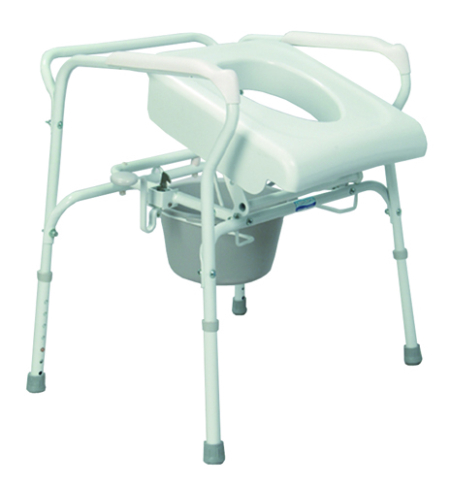
A powered toilet lift is designed to assist with the sit-to-stand movement. Our Argo Toilet Lift, for example, represents the powered category: it uses an electric lifting mechanism, supportive armrests, and a stable over-toilet frame to help guide the user through the transfer.
The Argo is commonly described as providing a substantial vertical lift, with specifications indicating approximately 13 to 14 inches of powered elevation and a weight capacity of approximately 440 pounds, depending on the specific manufacturer documentation and configuration. Review the current product specifications before ordering.
The safety advantage is most pronounced when the user:
- Cannot rise safely from a standard-height toilet.
- Experiences substantial lower-body weakness.
- Becomes unsteady during the transition from sitting to standing.
- Requires a caregiver to perform significant lifting.
- Has already experienced near-falls during bathroom transfers.
However, powered equipment is not automatically safe in every bathroom. The frame must fit properly, the user must remain within the stated weight capacity, and the surrounding floor area must remain clear. The device should also be used according to the manufacturer’s instructions.
2.2 Hinged raised toilet seat
A raised toilet seat reduces the distance the user must lower and rise. That can lessen stress on the knees, hips, and back while making transfers more manageable. It does not, however, provide active lifting assistance.
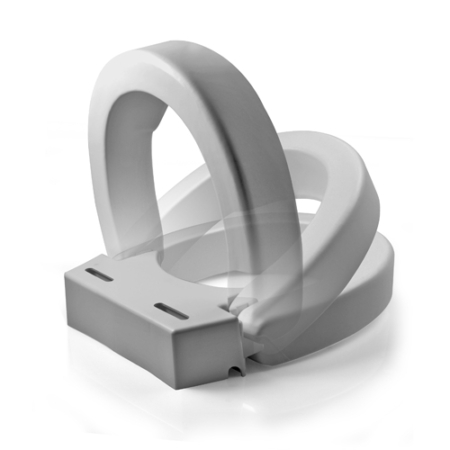
Our Raised Toilet Seat Standard Hinged elevates the seating position by 4 inches, uses the existing toilet seat and lid, and has a stated weight capacity of 300 pounds. The Raised Toilet Seat Elongated Hinged raises the seating position by 3 inches and is designed for elongated toilets.
A hinged seat may be a safe and effective option when the user can:
- Stand with reasonable control.
- Maintain balance while turning and sitting.
- Use a grab bar, toilet safety frame, or caregiver’s arm for additional support.
- Follow transfer instructions consistently.
If a user cannot stand safely even from the elevated height, a raised seat alone may not provide sufficient protection against falls.

3. Stability and Bathroom Fit
3.1 Powered toilet lift
A powered lift generally has a wider base and armrests that create a more supportive transfer platform. The Argo product category is designed to fit over the toilet while resting on the floor, rather than relying solely on the porcelain bowl for support.
Before installation, measure:
- Toilet rim height
- Toilet width
- Distance from the toilet to nearby walls
- Clearance for the user’s legs and mobility aid
- Door swing and available maneuvering space
A larger frame may improve stability but can become difficult to navigate in a compact bathroom. A walker or wheelchair may also require additional side clearance.
3.2 Hinged raised toilet seat
A hinged raised seat can preserve the familiar appearance and function of a conventional toilet. The seat remains attached to the existing toilet seat and lid, and the hinged design allows the ring to be lifted for cleaning.
The critical safety condition is proper installation. Hardware must be tightened securely, the seat must match the toilet shape, and the device must not wobble or shift under load. The seat should be checked periodically, particularly in a high-use household.
Important: A raised seat should not be treated as a grab bar. If the user needs support while standing, use a properly installed grab bar or an appropriate toilet safety frame.
4. Ease of Use and Independence
A powered lift requires the user to understand the control mechanism and remain positioned correctly while the seat moves. When used properly, it can support greater independence because the user may not need to push forcefully through the legs or rely entirely on a caregiver.
The movement may be slower than a conventional transfer. That is generally beneficial because controlled movement allows the user and caregiver to maintain better awareness of positioning.
A hinged raised toilet seat is simpler. It does not require a battery, switch, motor, or charging routine. The user sits and stands as usual, but from a higher position. This familiarity can be advantageous for someone who does not want to manage powered equipment.
The trade-off is equally clear: simplicity favors the raised seat, while mechanical assistance favors the powered lift.
5. Installation and Maintenance
5.1 Raised toilet seat installation
The hinged raised seat uses the existing toilet seat and lid and includes a hardware kit. Installation generally involves:
- Removing or loosening the existing toilet seat hardware.
- Positioning the riser correctly over the bowl.
- Reinstalling and tightening the hardware.
- Confirming that the seat is level and stable.
- Testing the seat before regular use.
No plumbing modification is ordinarily required. The seat can be a practical choice when the household needs an expedited bathroom adjustment without structural remodeling.
5.2 Powered toilet lift installation
Powered lifts often require assembly, adjustment of the legs, and placement over the toilet. Many models are designed for low-tool setup, but the installation still requires more attention than a simple height riser.
The user or caregiver should confirm:
- The unit sits level on the bathroom floor.
- The toilet is within the product’s approved dimensions.
- The power cord or charger is positioned safely.
- The frame does not interfere with the bathroom door or mobility equipment.
- The lift operates correctly before the first transfer.
Unforeseen circumstances, unusual toilet dimensions, uneven flooring, or insufficient clearance may require additional preparation.
6. Caregiver Effort and Liability Considerations
For caregivers, the most important distinction may be physical workload.
A raised toilet seat reduces the depth of the transfer but does not eliminate the need for hands-on assistance. If the user has limited leg strength, a caregiver may still need to stabilize the person, assist with clothing management, and help control the descent.
A powered lift can reduce the amount of force the caregiver must provide. Instead of attempting to lift the user manually, the caregiver may be able to focus on supervision, positioning, and safety monitoring. This can reduce caregiver strain and help limit the liability associated with unsafe manual transfers.
No bathroom device eliminates risk. Caregivers should avoid pulling forcefully on the user’s arms, rushing the transfer, or relying on unstable surfaces. If a transfer requires substantial lifting, consult a qualified professional regarding appropriate mobility aids for seniors and safe-transfer techniques.
7. Cost and Overall Value
Our current product listings provide a useful comparison point:
- Raised Toilet Seat Standard Hinged: $160.81
- Raised Toilet Seat Elongated Hinged: $178.66
Prices and availability can change. Powered lifts generally command a higher upfront investment because they include a motor, lifting frame, controls, and additional structural components. Their value is measured not only by purchase price, but also by the potential to reduce caregiver effort and support greater independence.
Budget Medical Supply offers flexible payment options through Klarna and Affirm, subject to approval and applicable terms. These options may help qualified customers distribute the cost of home medical equipment over time.
8. Who Should Choose Each Option?
8.1 A hinged raised toilet seat may be appropriate when:
- The user can stand and pivot with limited assistance.
- The primary difficulty is bending to a low toilet.
- The bathroom has limited floor space.
- A discreet, familiar-looking modification is preferred.
- The household wants a simpler and lower-cost solution.
8.2 A powered toilet lift may be appropriate when:
- The user cannot rise safely from a raised seat.
- Lower-body weakness or balance limitations are substantial.
- Caregivers are performing repeated manual lifting.
- The household can accommodate a larger frame.
- Greater mechanical assistance justifies the additional investment.
Final Decision
For many older adults with moderate mobility challenges, a hinged raised toilet seat can provide an efficient improvement in comfort and transfer height. For users whose primary concern is not height but insufficient strength to stand, a powered toilet lift such as the Argo Toilet Lift may be the more comprehensive solution.
The safest choice is the one that matches the user’s actual transfer ability, not simply the device with the most features. Measure the bathroom carefully, confirm weight and toilet compatibility, and seek professional input when balance or transfer safety is uncertain.
At Budget Medical Supply, we have served customers since 2001 with a wide product range covering mobility aids for seniors, bathroom safety equipment, diabetic care, daily living aids, and home medical equipment. We offer competitive pricing, fast shipping through USPS and FedEx, and flexible payment options through Klarna and Affirm.
For questions about product compatibility, contact us at 888-827-4472 or email admin@budgetmedicalsupply.com. We are pleased to help you compare your options.
